
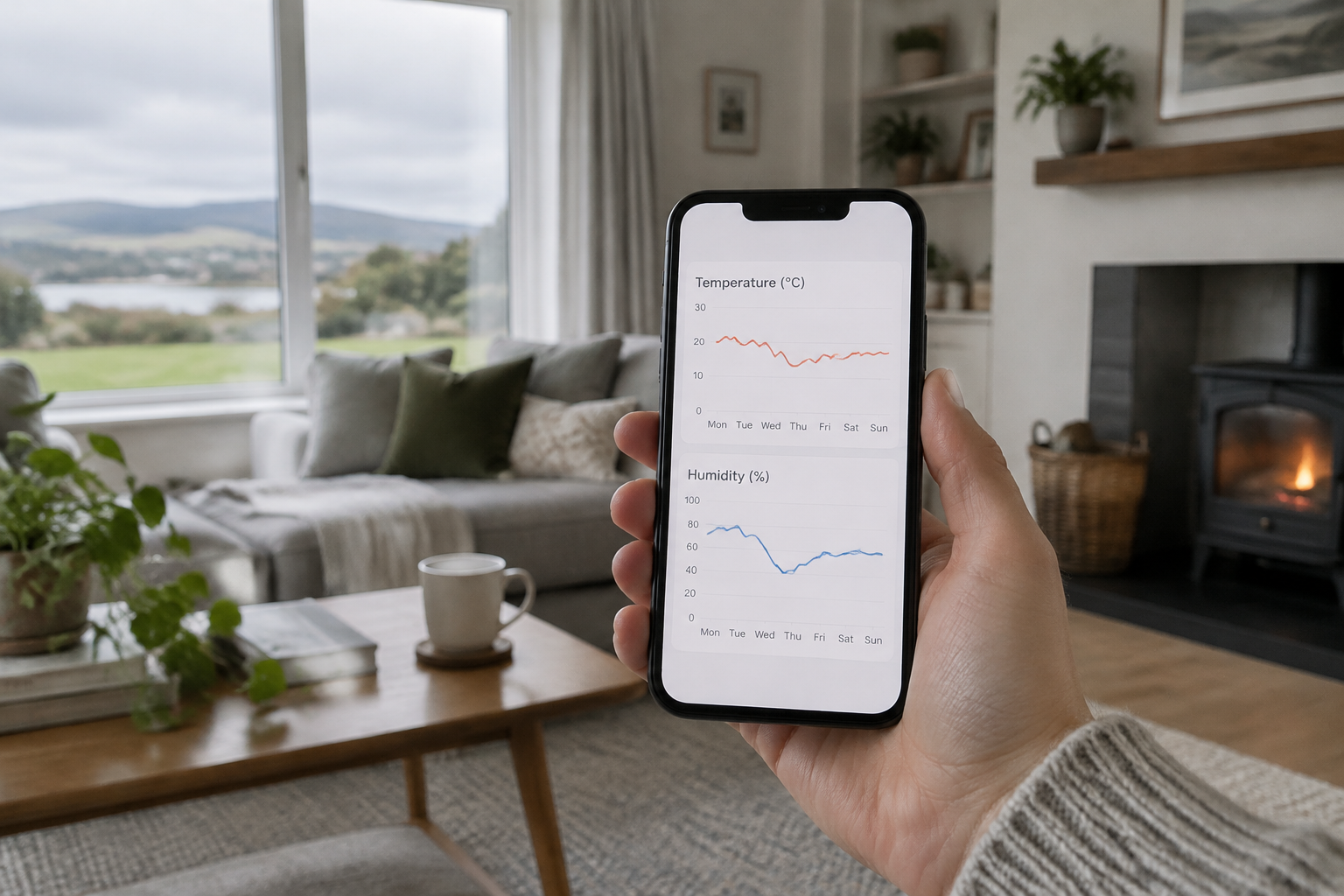
Home sensors can be brilliant for peace of mind—until they start pulling your attention into every wiggle of a graph. In most Irish homes, the goal isn’t to “win” at perfect readings. It’s to understand what’s normal for your house, your routines, and your local weather, then make small adjustments that improve comfort and day-to-day living.
Numbers are noisy; patterns are useful
A single reading is a snapshot. It can change quickly because someone boiled a kettle, the heat came on, a door opened, or the sun briefly hit a room. Trends—how your home behaves over hours and days—are far more informative than any moment-by-moment figure.
- Look for repeated daily shapes (for example: morning rise, afternoon dip, evening peak).
- Notice how long it takes to “settle” after cooking or showers.
- Compare like with like (weekdays vs weekends, occupied vs empty days).
Start with three simple baselines
If you’re not sure where to begin, choose three baselines to observe for a week: temperature stability, humidity behaviour, and ventilation recovery. This helps you focus on what changes your home most—without getting lost in detail.
- Temperature stability: does a room swing a lot between day and night, or stay fairly steady?
- Humidity behaviour: are there short spikes with quick recovery, or a consistently high “plateau”?
- Ventilation recovery: after a moisture-heavy activity, does the reading return to its usual range in a reasonable time for your home?
A calm approach: if you can explain a change (cooking, showers, visitors, clothes drying), treat it as information—not a warning.
Connect readings to real-life moments (the ‘why’ behind the line)
The fastest way to make sensor data useful is to link it to daily events. You don’t need a perfect log—just a few notes when something obvious happens. In many Irish households, the biggest drivers are cooking, showering, clothes drying, heating schedules, and whether internal doors are left open or closed.
- Cooking: does humidity rise and stay up after dinner, or drop once the kitchen clears?
- Showers: does the bathroom spike sharply and recover, or linger for ages afterwards?
- Laundry: do certain rooms show long, slow increases on drying days?
- Heating: do readings shift when the heating comes on/off (especially in shoulder seasons)?
- Doors: does closing a door contain a spike to one room, or spread it through the house?
Use ‘before and after’ checks instead of constant monitoring
Constant checking can make normal variation feel like a problem. A steadier method is to pick one habit to test, then compare patterns before and after. Keep the change small so you can tell what made the difference.
- Try running existing extractors a bit longer after showers and compare recovery time across a few similar days.
- If you often dry clothes indoors, compare a typical drying day with and without a window cracked for a period (weather permitting).
- If one room feels stuffy, compare trends with the door open vs closed during busy evening hours.
Avoid judging success by one day. Weather, occupancy, and routines can easily overwhelm a single comparison.
Watch for ‘persistent’ patterns, not one-off spikes
Spikes happen in real homes. What’s more informative is persistence: readings that stay elevated for long stretches, or a baseline that slowly drifts in one direction over weeks. Persistence can point to routines, ventilation habits, or room usage that’s worth revisiting.
- Regular evening build-up that doesn’t recover overnight.
- A room that is consistently different from the rest of the home (warmer, cooler, damper-feeling).
- Changes that track the seasons (for example, a noticeable shift when heating starts).
A quick reality-check for Irish weather and older housing
Ireland’s outdoor humidity and frequent rain can make indoor trends feel “stubborn,” especially in older or less airtight homes, or in houses with limited mechanical ventilation. That doesn’t mean sensors are pointless—it means context matters. On damp days, it may take longer for indoor conditions to settle, and your best insight may come from noticing which routines help your home recover more consistently.
Sensors can support better decisions, but they can’t replace common sense: comfort, condensation you can actually see, and how spaces are used still matter.
A simple weekly routine that keeps data helpful
If you want the benefits without the stress, keep your review lightweight. Spend 10 minutes once a week looking at broad trends, not every fluctuation.
- Pick one room you care about most (often a bedroom or the main living space).
- Look for the week’s ‘shape’: when does it peak, when does it settle?
- Identify one repeatable cause (showers, cooking, laundry) and one small adjustment to try next week.
- Note the result in plain language: “Recovered faster after showers,” or “Evening build-up still lingering.”
When you treat sensor readings as a story about how your home behaves—rather than a test you can fail—you get clearer, calmer insight. Over time, that context helps you make practical choices that fit your house, your family, and Irish weather without chasing every number.