
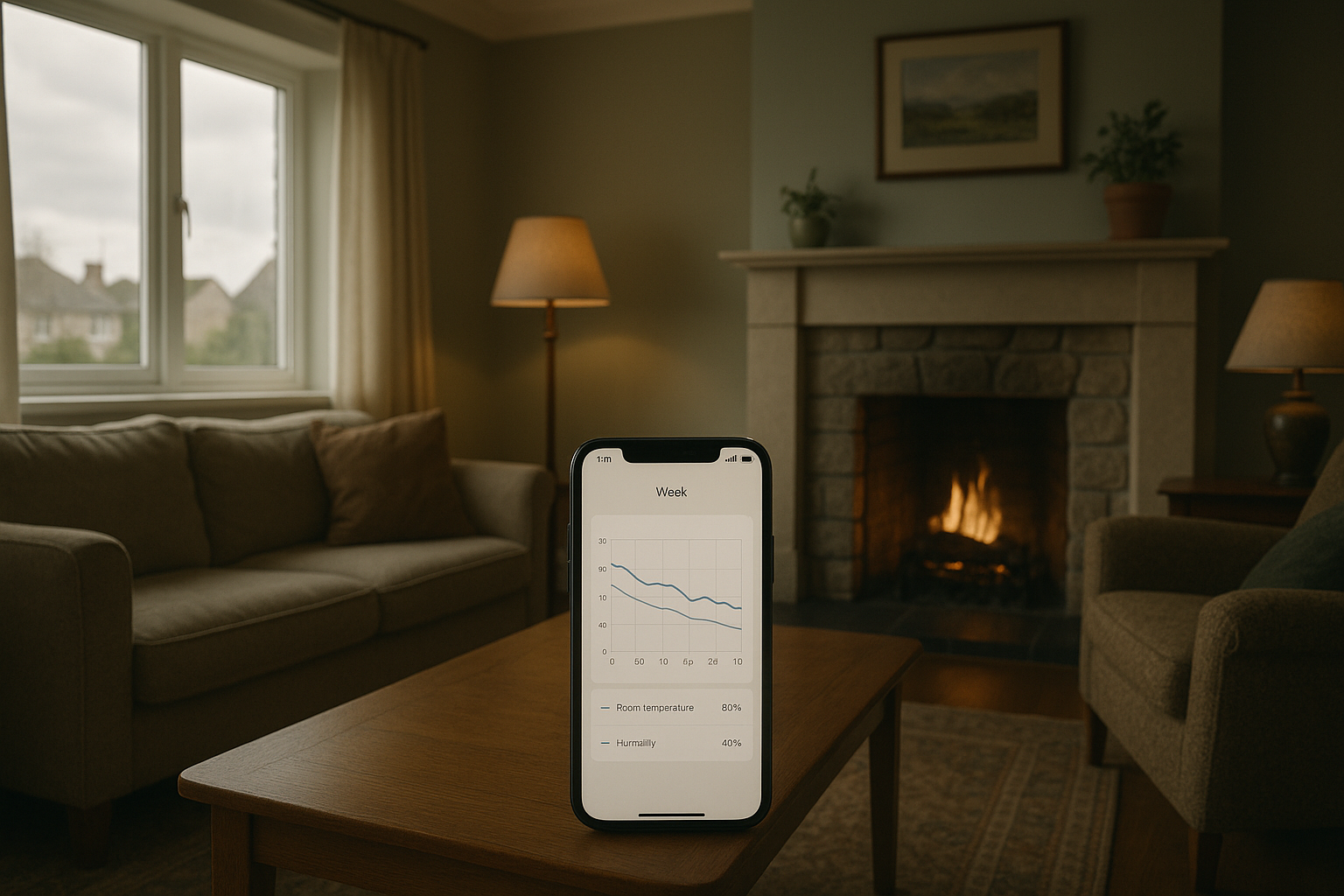
If you’ve been checking room readings for a while, a “quiet” week can feel like a non-event. But steady data is useful: it gives you a baseline. Once you have that baseline, small changes—weather shifts, a new routine, turning the heating down—become easier to notice and interpret.
In Irish homes, where outdoor conditions can swing from damp to bright to windy within a day, a steady week indoors often says more about your habits (and your home’s response) than it does about any single reading at a single moment.
1) Your home’s “normal rhythm”
Over seven days, you usually start to see repeating shapes: a morning rise when the heating comes on, an evening bump when cooking happens, and an overnight drift as the house cools. That rhythm is valuable because it helps you distinguish normal daily movement from unusual behaviour.
- What time rooms warm up and cool down (and how quickly)
- Whether weekends behave differently to weekdays
- How long it takes the house to recover after showers or cooking
- Whether bedrooms stay cooler than living spaces overnight
2) The difference between “stable” and “stagnant”
Steady readings can reflect a consistent, comfortable setup—especially if doors, heating schedules, and extraction are used in a similar way each day. But “steady” can also mean that moisture and warmth are simply staying in the same place because air isn’t moving much.
A helpful way to think about it is context: if humidity rises during showers and then gradually returns to its earlier level, that suggests moisture is dispersing and being removed over time. If it rises and stays up for long stretches, it may be a cue to review extractor use, door positioning, or how long windows are opened—without jumping to conclusions from one day.
3) Room personality: kitchens, bathrooms, bedrooms, and “that cold corner”
Different rooms behave differently, even in the same house. A steady week helps you see which spaces are naturally more variable and which are consistently calm. That’s useful when you’re deciding where to focus small changes.
- Kitchens: short, sharp humidity increases around cooking times
- Bathrooms: spikes that depend heavily on extractor fan use and door position
- Bedrooms: cooler temperatures overnight with humidity drifting upward while the room is occupied
- Hallways/landings: surprisingly stable readings, acting like a “buffer” space
4) Heating schedule signals (without overthinking it)
A week of data can reveal whether your heating pattern is doing what you think it’s doing. You might discover the house warms later than expected, or that one room lags behind others. This isn’t about chasing perfect numbers; it’s about aligning comfort with how the home actually responds.
- A delayed temperature rise after the heating turns on (slow response)
- Big room-to-room gaps at the same time of day (heat distribution)
- Regular evening “plateaus” where temperature stops rising (thermostat location or heat loss)
- Night-time drops that are sharper than you expected (drafts or low thermal mass in that space)
5) Weather sensitivity—how much outdoors controls indoors
Irish weather can drive indoor humidity and comfort in subtle ways. A steady week indoors, especially across a mix of wet and breezy days, can show how “coupled” your home is to outside conditions. Some homes track outdoors closely; others stay more insulated from it.
If your readings barely move even when the weather changes, that can be a sign of consistent routines and a stable building fabric. If they move a lot, it might simply mean you’re opening windows frequently, using intermittent heating, or living in a more exposed location.
A simple way to use a steady week: three quick comparisons
- Weekdays vs weekend: do cooking, laundry, and showers shift the pattern?
- Morning vs evening: is the home consistently comfortable when you’re actually using the rooms?
- Same room, same hour: does 8pm look similar each day, or is it drifting over the week?
Even if you only spot one clear pattern—like the bathroom staying humid for longer than you thought—that’s progress. You’ve turned “a feeling” into something you can act on calmly.
Low-effort next steps (no big projects required)
- Run the bathroom extractor for longer after showers and see if the return-to-baseline time changes
- Keep an internal door open (or closed) at a consistent time and compare the room-to-room difference
- Shift a short window-opening routine to a different time of day and watch how quickly readings settle
- Try drying clothes in the same place but with a consistent airflow approach for a week, then compare to the previous week
Note: Room readings are a guide, not a verdict. They don’t diagnose building issues on their own, and a stable-looking week doesn’t guarantee anything. Use the patterns as gentle prompts—especially when combined with what you see (condensation on windows), feel (stuffy air), and do (showers, cooking, laundry).