
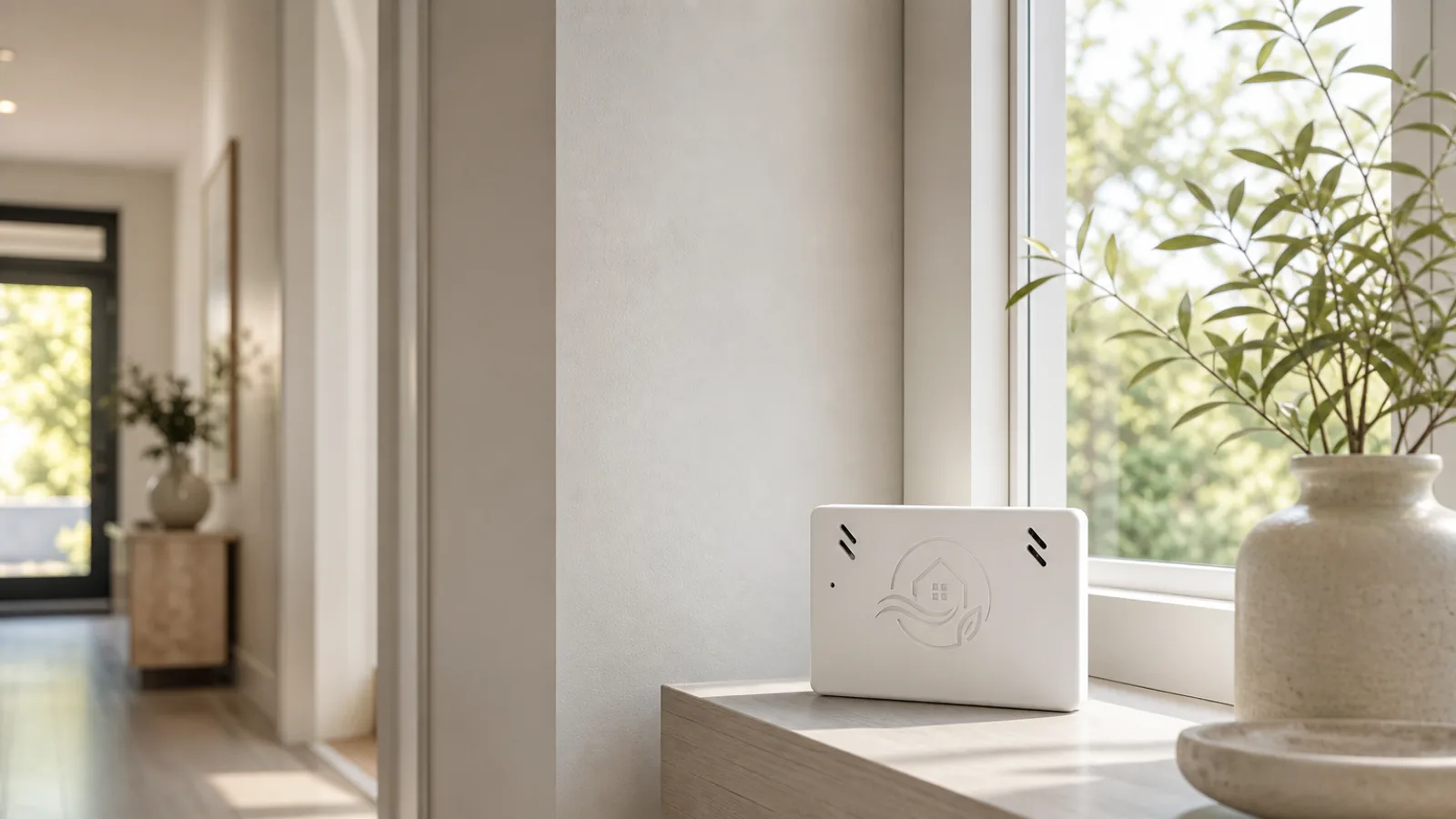
Smart home sensors do not see mould. They do not diagnose mould. They cannot look inside walls, under floors, or behind furniture. What they can do is record how a room’s air behaves over time: humidity, temperature, and — where measured — how quickly occupied air appears to be replaced.
That is a quieter kind of evidence than a stain on paintwork. It is also easier to over-read. Repeating moisture patterns can help reveal rooms that stay damp, recover slowly, or sit cooler than the rest of the home. They do not prove mould is present, they do not predict that mould will appear, and they do not guarantee that it will not.
Moisture patterns before anything is visible
A room sensor samples the air around it. It can help describe whether humidity stays high after a shower, whether a spare room remains cooler and damper than the lived-in rooms, or whether a closed bedroom recovers slowly overnight. It cannot identify growth on a surface, locate a hidden leak, or declare a building healthy.
Visible mould, when it is present, is a surface finding. Sensors do not replace looking, and they do not replace a property survey or remediation professional. They can only add context about the conditions the room has been spending time in.
Why trend history matters more than one reading
A single humid evening after cooking or bathing is a weak snapshot. Many homes look damper for a short time and then recover. The more useful question is whether the same cycle repeats: a bathroom or bedroom that stays elevated, a room that recovers more slowly than its neighbours, a corner that remains cooler night after night.
Patterns across several days can help reveal whether a habit, a closed door, a heating gap, or limited ventilation is keeping a room in moist conditions for longer than adjoining spaces. That is still interpretation, not proof of a defect, and not a forecast of visible damage.
Condensation risk, cold surfaces, and everyday habits
Air temperature and surface temperature are not the same. External walls, window glass, unused corners, and rooms above unheated spaces often run cooler than the middle of a lived-in room. When moist air meets a cooler surface, condensation can form. Relative humidity in the air can also stay high when the room is cool and poorly mixed.
Closed rooms reduce mixing with the rest of the home. Heating that drops away from a hallway thermostat can leave a spare bedroom cooler overnight. Limited ventilation — extract used too briefly, trickle vents shut, windows rarely opened — can leave moisture with fewer places to go. Those are conditions worth noticing. They are not a diagnosis of mould, and they do not mean mould is inevitable.
Why visible mould is often a late signal — and not a guaranteed one
When mould is noticed on a wall or ceiling, the room may already have spent a long time in damp or poorly recovering conditions. Visual mould can therefore be a late signal. It is not a guaranteed next step. Some rooms spend time in moist conditions without a visible outbreak. Some visible problems have causes a room sensor will never see, such as a leak in a cavity or a roof defect.
That is why “before problems become visible” is a cautious phrase, not a promise. Sensors may help people notice repeating moisture behaviour earlier. They cannot promise that problems will appear, or that they will not. Healthy Home Intelligence does not claim to prevent mould.
How Healthy Home Intelligence supports earlier decisions
Healthy Home Intelligence is designed to help homeowners understand patterns earlier. Seeing that a room stays damp after bathing, or that a closed bedroom does not recover overnight, can support a calmer next step: run extract for longer, stop drying clothes in a closed room, check vents, adjust a heating habit, or ask for an inspection if the pattern persists.
For homes with recurring moisture or ventilation concerns, monitoring can support better decisions. The aim is earlier understanding, not fear. The product is not a medical device. It does not diagnose illness. It does not make medical claims. It does not automatically control a home.
Evidence for a calmer conversation — not a legal finding
Homeowners, landlords, installers, and service providers often argue from a single damp patch or a single uncomfortable night. Room-level patterns can make the conversation more specific: this room recovers slowly after showers; this unused bedroom stays cooler and damper than the landing; this behaviour repeats across several days.
That evidence still needs judgement. It can support a request for better ventilation use, a heating review, or a professional inspection. It is not a certificate, not a legal finding, and not a substitute for a surveyor where leaks or structural damp are suspected. HHI does not replace a property survey or remediation professional.
What to do next
If a moisture pattern keeps repeating, review the obvious sources first: ventilation, heating, closed doors, and how the room is used. If visible mould, damp, or building defects are present, professional investigation may still be needed. Do not treat a chart as proof that mould is coming, and do not treat a calm chart as proof that a hidden problem cannot exist.
Healthy Home Intelligence is in prelaunch. The public site is here so people can understand the approach and request early access. Join the waitlist if you want launch updates, pilot invitations, and product availability.
Not a substitute for professional inspection where leaks, structural damp, visible growth, or suspected defects are present. Monitoring may indicate conditions worth a closer look; it does not replace a surveyor or remediation specialist. Sensors do not see or diagnose mould and cannot guarantee it will not appear. This is not medical advice.