
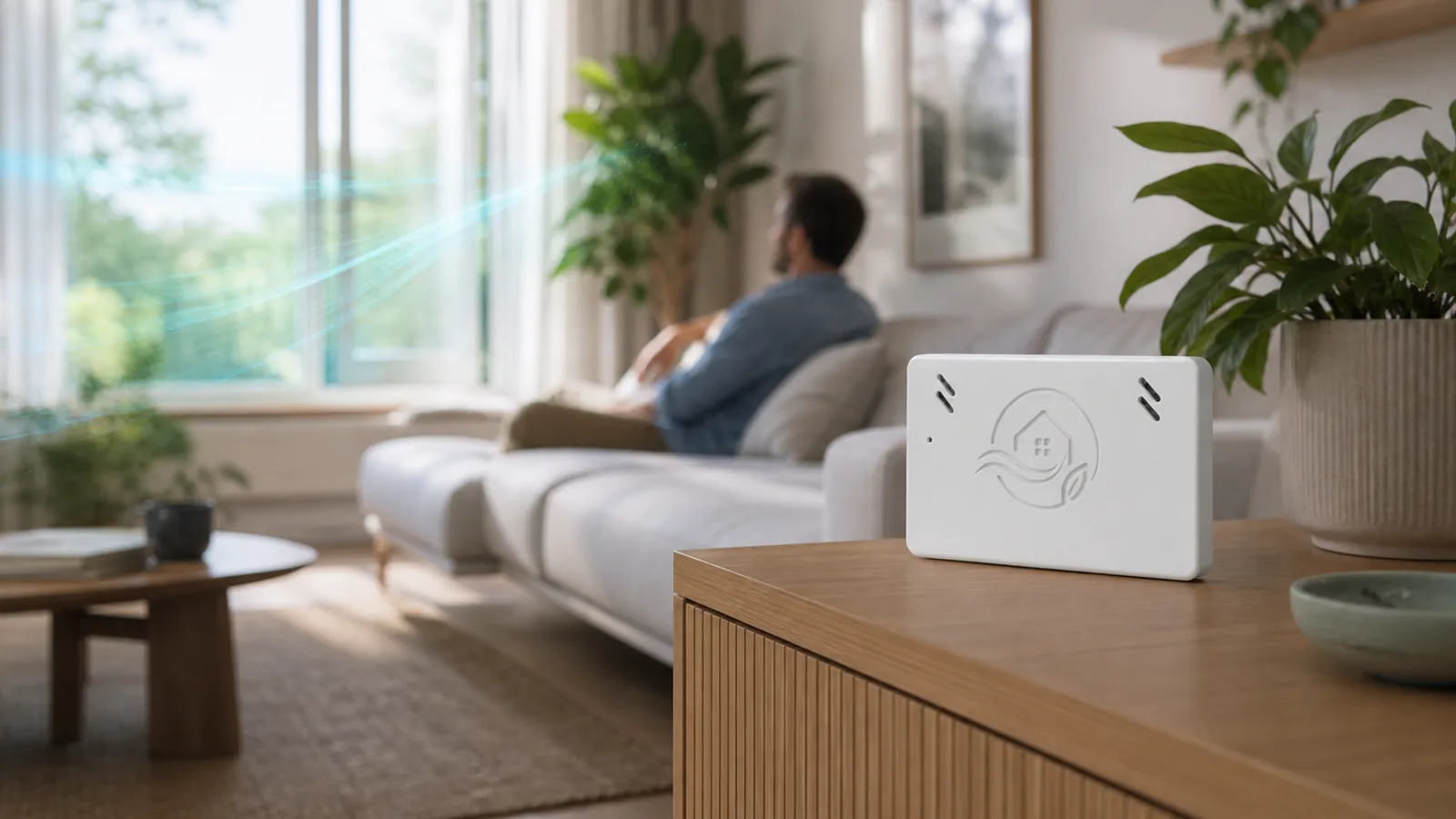
In a home, carbon dioxide (CO₂) is usually a story about people and air exchange. Occupied bedrooms, living rooms, and home offices produce CO₂. Fresh outdoor air — or air from better-connected parts of the house — dilutes it. When a door stays shut and little air is replaced, levels can rise. When the room opens up, they can fall.
That makes CO₂ a useful ventilation signal in ordinary rooms — not a complete indoor-air score, not a panic trigger, and not a diagnosis of anyone’s health. The useful picture for most homeowners is simple: a closed bedroom overnight, a living room in the evening, a home office used for hours, a door that stays shut, a window habit that repeats.
CO₂ as a calm ventilation signal
CO₂ in indoor air largely comes from people breathing. In a small bedroom, two people behind a closed door can change the mix of the room’s air more quickly than one person in a large, open living space. The number on a display is not a verdict on the building. It is a trace of how many people were there, for how long, and how much of the room’s air was replaced while they were there.
When ventilation is limited — trickle vents closed, extract not running, windows shut, little transfer to the landing — CO₂ can climb while the room is occupied and ease when the door opens or the room is left empty. That pattern can help reveal how the room is actually used. It does not, by itself, prove a defect.
One spike versus a repeating pattern
A single elevated reading is easy to over-read. Guests in a closed room, a long meeting at home, or an evening with every door shut can create a short climb that later recovers. The calmer question is whether the same behaviour repeats: several nights in the same bedroom, several occupied evenings in the living room, or a home office that stays elevated every working day.
Trend history matters more than a one-off number. Looking across several occupied periods can help reveal whether a room recovers when air can move, whether the late-night climb returns, and whether one room keeps diverging from the rest of the home.
Bedrooms, living rooms, and home offices
A bedroom at night is a common example. People stay in a small volume of air for hours. The door may be closed for privacy, warmth, or quiet. Outdoor air may not be invited in. CO₂ can rise even when nothing dramatic has happened.
A living room during a long evening with the door shut tells a similar story with more movement and more people coming and going. A home office can sit closed for much of the day with one person breathing in a small space. The useful question is not “is this number alarming?” It is “does this room mix with the rest of the home, and how quickly does it recover when occupancy or the door changes?”
Doors, windows, vents, and everyday habits
A closed door reduces mixing with hallways, stairs, and rooms that may have more movement or a clearer path to extract fans. Many people close bedroom doors overnight. That is ordinary. What matters is the pattern that follows: does CO₂ rise and then ease, or does it stay elevated until morning? Does opening the door, a vent, or a window change the recovery?
Window habits and ventilation hardware change the same story. A slightly open window, a trickle vent that is actually open, or an extract fan used after a shower can all increase air replacement. A sealed window, a vent left shut, or a fan that is rarely used can do the opposite. Those facts are context for interpreting the pattern — not a judgement of the homeowner.
Why rooms in the same home diverge
Two rooms in the same home can diverge. One may be occupied; the other empty. One may be smaller. One may have more window area, a different door habit, or more connection to the landing. Occupancy, volume, furnishings, and how often the door stays closed all change how quickly fresh air replaces stale air.
A living room that recovers quickly after evening use does not explain a closed bedroom that stays occupied until morning. Room-level monitoring exists to make that difference visible — not to rank rooms as good or bad from one snapshot, and not to certify that the whole house is “properly ventilated.”
What CO₂ cannot tell you
CO₂ in this context is an environmental clue, not a clinical measurement. It does not diagnose illness. It does not explain symptoms. It does not replace medical advice. A rise overnight in a closed bedroom is often a ventilation clue, not a toxicity alarm and not a health assessment of the people in the room.
A comfortable CO₂ reading also does not prove a home is free of moisture issues, particles, or other indoor-air questions. CO₂ does not measure water vapour. It does not see hidden leaks. It cannot certify building compliance or stand in for a professional inspection where defects, combustion appliances, or persistent concerns need a specialist.
How other room readings add context
Humidity helps describe how much moisture the air is holding at the current temperature. A closed bedroom can show a CO₂ rise from occupancy and a humidity rise from cooler overnight air or moisture sources. Reading those together is more useful than treating either number as a complete score.
Temperature gives humidity its meaning. Particle readings can add context after cooking, nearby traffic, or a dusty period. Pressure can help place indoor behaviour in a wider weather context. Together, these readings can support a calmer question: is this room simply occupied and closed, or does it keep behaving unlike neighbouring rooms across several days?
How Healthy Home Intelligence helps homeowners notice patterns
Healthy Home Intelligence is designed to help homeowners understand patterns earlier. Seeing the same late-night climb, the same slow recovery after a closed workday, or the same bedroom-versus-living-room difference can support earlier, calmer decisions without turning the house into a laboratory.
The aim is intelligent awareness: open a door, review a window or vent habit, compare rooms, or ask a professional to look if the pattern persists alongside other concerns. HHI does not automatically control the house. It does not make medical claims. It does not claim to prevent mould, illness, damage, or poor air quality.
Practical next steps
If a closed bedroom, living room, or home office repeatedly climbs while occupied and recovers when air can move, the proportionate next step is often a habit check: door position, trickle vents, extract use, or whether a window is ever opened during repeated stale-air periods. For homes with recurring ventilation concerns, monitoring can support better decisions.
If the pattern persists, or if there are signs of damp, combustion concerns, or suspected defects, professional investigation may still be needed. This page cannot inspect a specific home. Room-level patterns are a calmer starting point for a conversation — not a certificate, not a diagnosis, and not a substitute for a surveyor or ventilation specialist.
A calm way forward
If this occupied-room pattern is familiar, the useful next step is not to assume the worst. It is to watch how the room behaves, compare it with other rooms if you can, and decide whether a small ventilation habit or a professional inspection is the proportionate response.
Healthy Home Intelligence is in prelaunch. The public site is here so people can understand the approach and request early access. Join the waitlist if you want launch updates, pilot invitations, and product availability.
CO₂ guidance here is educational. It is not medical advice and not a substitute for professional inspection where defects, combustion appliances, or persistent air-quality concerns need a specialist. Monitoring may indicate conditions worth a closer look; it does not replace a surveyor or ventilation specialist.