
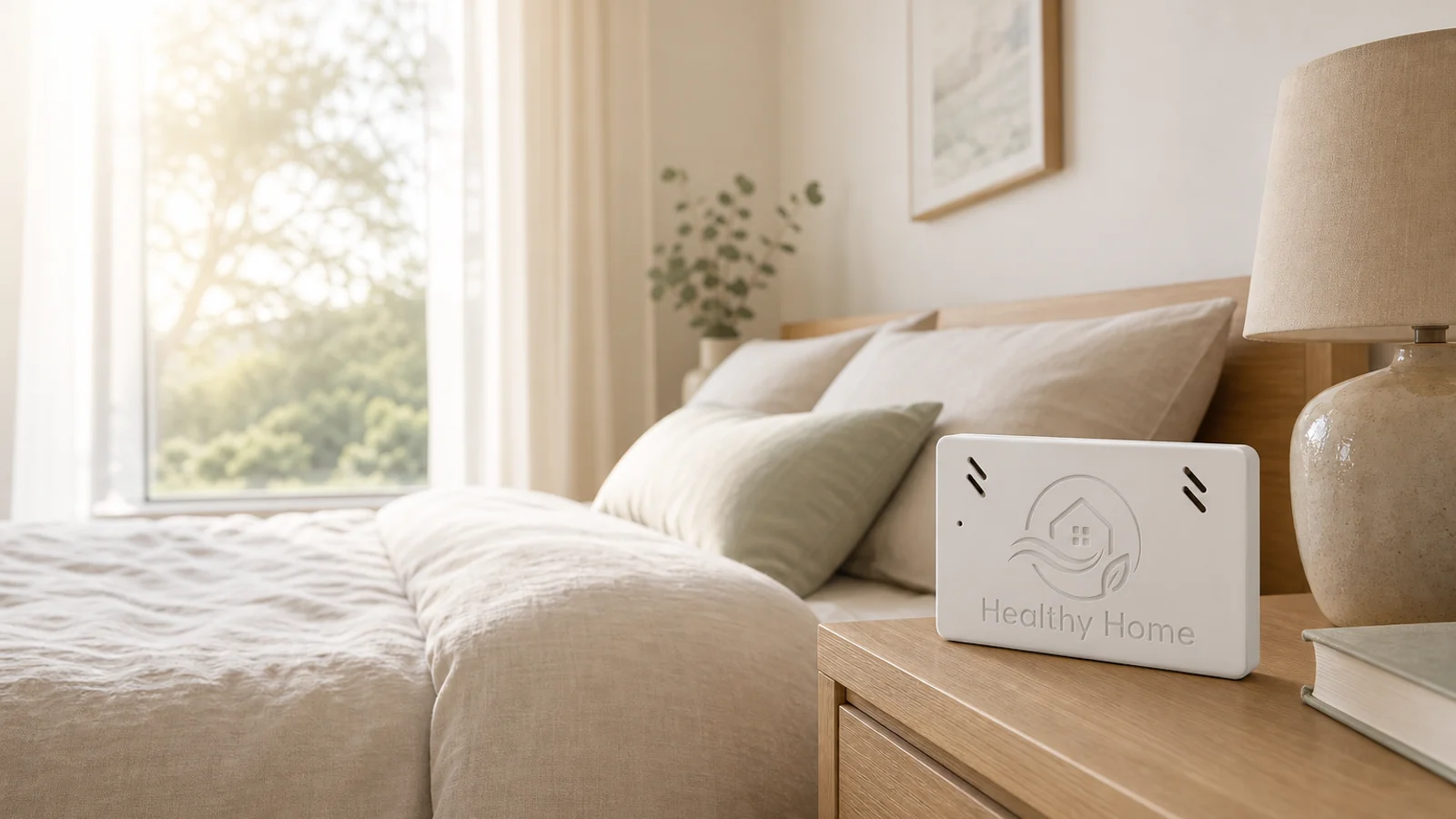
Many bedrooms look comfortable at bedtime and feel different by morning. Relative humidity often rises overnight because the room is quieter, cooler, and more closed than the rest of the house. That change is usually ordinary indoor physics, not a verdict on the home and not a diagnosis of anyone’s health.
This article explains why those overnight shifts happen, why one bedroom can behave differently from another room, and why a hallway thermostat cannot explain bedroom comfort. It also explains how room-level monitoring — looking at humidity alongside temperature, carbon dioxide, particles, and pressure where they are available — can support calmer interpretation. Healthy Home Intelligence is being built around a simple sequence: measure, interpret, then act. None of this replaces a professional inspection where leaks or defects are suspected.
Why bedroom humidity often rises overnight
Relative humidity describes how close the air is to holding as much water vapour as it can at the current temperature. It is not a standalone wetness score for the building. When the same amount of moisture sits in cooler air, relative humidity rises. Bedrooms often cool after lights-out. Heating may drop. Outdoor air cools. The room is also a small volume of air compared with an open-plan living space.
Overnight, people add moisture simply by breathing and by using the room. Bedding, a recent shower, damp towels, or clothes left to air can add more. If less outdoor air or less air from the rest of the house enters the room, that moisture has fewer places to go. The result can look sharp on a graph even when nothing dramatic has happened.
A single humidity number at bedtime can look comfortable while the same room spends several hours cooler and damper. Overnight patterns can help reveal how a bedroom recovers, whether moisture lingers, and which daily habits keep repeating. That is useful context. It is not proof of a defect, and it is not a medical assessment.
Why closed doors and reduced ventilation matter
A closed bedroom door reduces mixing with the rest of the home. Hallway air, stairwells, and living rooms often have more movement and more connection to extract fans or trickle vents. Once the door is shut, the bedroom becomes its own small climate for several hours.
Reduced ventilation does not automatically mean a room is a problem. Many people close doors for privacy, warmth, or quiet. The useful question is what happens next: does humidity rise and then ease, or does it stay elevated until morning? Does opening the door, a vent, or a window change the recovery? Patterns across several nights are more informative than one closed-door evening.
If extract fans, trickle vents, or a slightly open window are not in use, moisture and stale air can linger longer. That can be a reason to review a habit. It is not, by itself, evidence of hidden damage.
Cooler surfaces and heating patterns
Air temperature and surface temperature are not the same thing. External walls, window glass, and unused corners often run cooler than the middle of the room. When moist air meets a cooler surface, condensation can form. Relative humidity in the air can also rise as the room cools, even before any surface looks wet.
Heating patterns matter because many homes reduce heat overnight. A hallway or living-room thermostat may still look settled while a closed bedroom cools faster. A room above an unheated space, on a gable wall, or with a large window can lose heat differently from a room in the middle of the house.
None of this means overnight cooling is unsafe or that heating must stay high. It means comfort and moisture behaviour are local. A room that stays cooler and damper than adjoining spaces, night after night, may be worth a closer look at ventilation, heating, and moisture sources — or a professional inspection if the pattern persists alongside visible damp.
Why one bedroom can behave differently from another room
Two bedrooms in the same house can tell different stories. One may be occupied; the other empty. One may have an ensuite. One may face prevailing weather. One may be used for drying clothes. Occupancy, volume, furnishings, and how often the door stays closed all change how moisture and heat move.
Comparing rooms is therefore more useful than treating the house as one average. A living room that recovers quickly after evening use does not explain a north-facing bedroom that stays closed until morning. Room-level monitoring exists to make that difference visible, not to rank rooms as good or bad from a single snapshot.
Why a hallway thermostat cannot explain bedroom comfort
A hallway thermostat measures temperature in one place, at one height, for the purpose of calling for heat. It does not measure bedroom humidity. It does not measure how quickly air is replaced behind a closed door. It cannot see a cooler external wall or a window that runs colder than the landing.
Comfort in a bedroom is a local mix of temperature, moisture, and air exchange. If the landing is warm and the bedroom door is closed, the thermostat can be satisfied while the bedroom still cools, holds moisture, or feels stuffy. That is a limitation of a single control point, not a failure of the occupant.
Room-level readings do not replace a heating engineer or a building survey. They can show that the bedroom is not the hallway, which is often the first useful fact.
How room-level monitoring helps reveal patterns
A one-off humidity number is a weak snapshot. Looking across several nights can help reveal whether a room recovers quickly after occupancy or stays elevated. It can show whether the same late-night peak repeats, and whether one bedroom diverges from the rest of the home.
Healthy Home Intelligence is being built to help people see those patterns without turning the home into a laboratory. The aim is earlier, calmer decisions: open a door, change how laundry is dried, review vents, adjust a heating habit, or ask a professional to inspect if the pattern persists. It does not automatically control the house, and it does not claim to prevent mould, illness, or damage.
How other room readings support interpretation
Humidity is easier to interpret when it is not read alone. Temperature gives relative humidity its meaning: the same moisture load looks different in a warmer room than in a cooler one.
Carbon dioxide can help reveal how quickly fresh air replaces stale air while a room is occupied. A rise overnight in a closed bedroom is often a ventilation clue, not a toxicity alarm and not a health diagnosis.
Particle readings describe airborne particles. They can add context after cooking, nearby traffic, or a dusty period. They do not measure moisture and they do not diagnose illness. Pressure can help place indoor behaviour in a wider weather context, because outdoor conditions influence how a house exchanges air. Pressure is supporting context, not a room-comfort score by itself.
Together, these readings can support a more complete picture: is the bedroom simply occupied and closed, cooling with the night setback, or behaving unlike neighbouring rooms for several nights in a row? Interpretation still needs judgement. Sensors read the air in a room. They cannot inspect cavities, roofs, or hidden leaks.
Measure, interpret, act
The Healthy Home Intelligence principle is straightforward. Measure what the room is doing over time. Interpret the pattern in context — occupancy, weather, heating, and how the room is used. Then act in proportion: a habit change, a ventilation check, or professional help where defects or visible damp are suspected.
That sequence is deliberately unspectacular. It is meant to reduce guesswork, not to replace building expertise or medical care. Monitoring may indicate conditions worth a closer look. It does not inspect the reader’s home from this page, and it does not promise a particular outcome.
A calm next step
If this overnight pattern is familiar, the useful next step is not to assume the worst. It is to watch how the room behaves, compare it with other rooms if you can, and decide whether a small habit change or a professional inspection is the proportionate response.
Healthy Home Intelligence is in prelaunch. The public site is here so people can understand the approach and request early access. Join the waitlist if you want launch updates, pilot invitations, and product availability.
Not a substitute for professional inspection where leaks, structural damp, or suspected defects are present. Monitoring may indicate conditions worth a closer look; it does not replace a surveyor or remediation specialist. This is not medical advice.